
Local SEO is the practice of optimizing your online presence to rank higher in searches that include a geographic modifier, like a city name or “near me.” It is distinct from national SEO in both mechanism and timeline. The primary goal for most small businesses is not to rank on page one of Google broadly, but to appear in the local pack: the block of three business listings with a map that shows up near the top of results for searches like “dentist Frisco” or “plumber near me.” Google Business Profile (GBP) is the single most impactful ranking signal for the local pack, outweighing most website factors. Review quantity and recency, citation accuracy (your business name, address, and phone number matching across directories), and on-page local signals all contribute. The local pack captures a large majority of clicks for local searches, so being in or out of those three spots matters more than where your website ranks below it. Most small businesses can handle the foundational work themselves. The tasks that genuinely benefit from professional help are citation audits, link building, and ongoing technical maintenance. Visible pack movement typically takes 3 to 6 months of consistent effort.
What Local SEO Actually Is (and What It Is Not)
Local SEO is the work you do to show up when someone nearby searches for what you offer. That could be “Frisco dentist,” “coffee shop near me,” or “emergency plumber 75034.” The geographic element is what sets it apart from standard SEO.
National SEO is about ranking for terms not tied to a specific place. A law firm ranking for “how to write a will” is doing national SEO. That same firm targeting “estate attorney Frisco TX” is doing local SEO. The signals, timelines, and tactics that work are different for each.
For brick-and-mortar businesses and service-area businesses (contractors, cleaners, mobile services), local SEO is what actually drives customers. Someone searching “plumber near me” is ready to hire. Local search captures the ready-to-buy query.
Local SEO targets two result types: the local pack (the map-based block of three listings near the top of results) and the organic results below it. Both matter, but the local pack is where most clicks go for “near me” and city-specific searches. Local pack SEO (sometimes called Google Maps SEO) refers specifically to ranking in that map block.
The Local Pack: Why This Real Estate Matters More Than Organic
The local pack is the block of three business listings that appears near the top of Google results for local searches. It includes a map, each business’s name, rating, number of reviews, address, and hours. For searches like “dentist near me” or “Frisco HVAC company,” these three listings get the overwhelming majority of clicks.
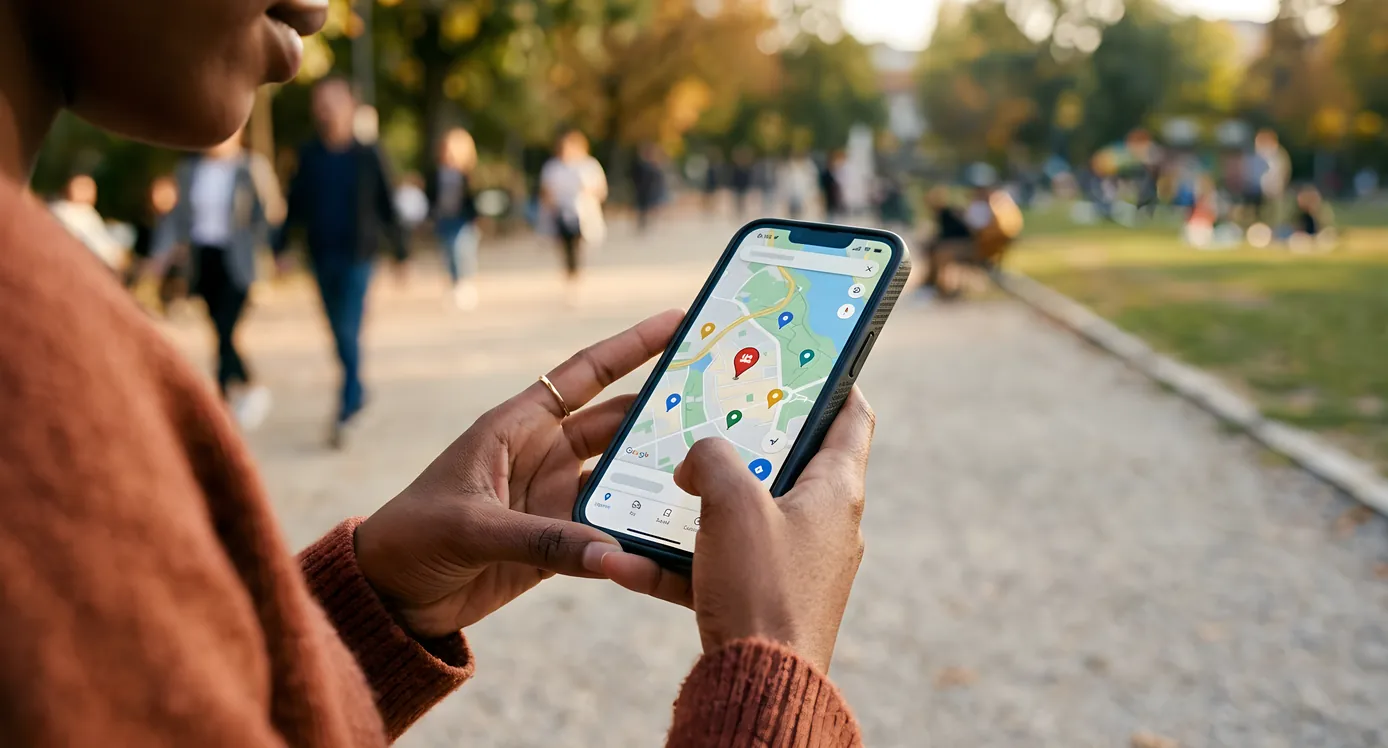
Picture a Frisco resident searching “pizza delivery near me” at 6:30 pm. They see a map and three restaurant listings. They click the one with 200 reviews and a 4.7 rating. The organic results below the pack rarely get touched for that type of search.
This means a business with a basic website but a strong GBP and good reviews can outperform a competitor with a far more polished site. A well-designed website won’t save you if you’re not in the pack.
Organic results below the pack still matter for higher-funnel queries: “what should I look for in a family dentist” or “how often should I get my HVAC serviced.” But for the ready-to-hire searches, the pack is the battleground. A business can appear in both; different signals drive each. For most small businesses, the pack is the right first priority.
Google Business Profile: The Signal That Outweighs Everything Else
Google Business Profile (GBP) is the free Google listing that powers local pack rankings. It is where you set your business name, category, address, hours, photos, and services. It is also where Google reviews appear. If you do one thing for local SEO, it is fully optimizing this listing.
A complete GBP listing signals to Google that your business is active, legitimate, and relevant to local searches. An incomplete or neglected listing signals the opposite.
The highest-impact GBP tasks, in order:
-
Set your primary category correctly. This is the single biggest lever in your GBP. Primary category tells Google what type of business you are. “Dentist” ranks for different searches than “Cosmetic Dentist” or “Pediatric Dentist.” Choose the most specific accurate category that matches your core service.
-
Complete every field. Business description, hours (including holiday hours), phone number, website URL, and service area or address. Gaps in this data are gaps in your relevance signal.
-
Add photos consistently. Google tracks whether businesses add photos over time. A listing with 5 photos from 2022 looks abandoned. Aim for new photos monthly: your space, your team, your work.
-
Use the Q&A section. Anyone can ask questions on your GBP listing. If you don’t answer them, someone else might. Seed it with common questions you get from customers and answer them yourself.
-
Post updates regularly. GBP posts (short updates, offers, or announcements) signal that your listing is actively managed. Frequency matters more than polish.
Storefront vs. service-area businesses: If you have a physical location customers visit, enter your address and set your listing as a storefront. If you go to customers (a plumber, a mobile dog groomer), set your listing as a service-area business and define your service radius. Don’t enter a home address as a storefront if you don’t receive customers there.
For a deeper look at every setting worth your attention, the guide to Google Business Profile optimization covers the full setup in detail.
Citations and NAP Consistency: Necessary but Not Sufficient
A citation is any online mention of your business that includes your Name, Address, and Phone number. This combination is abbreviated as NAP. Citations appear on directories like Yelp, Apple Maps, and Bing Places, as well as on industry-specific sites (for example, Healthgrades for medical practices, Houzz for contractors).
Google uses citation data to verify that your business information is accurate and consistent. When your business name appears as “Frisco Family Dental” on Google but “Frisco Family Dental, LLC” on Yelp, and “FFD Associates” on an old chamber of commerce listing, those inconsistencies create noise. Google is less confident in your data, which can suppress your local rankings.
The directories that matter most, in rough priority order:
- Tier 1 (essential): Google Business Profile, Yelp, Apple Maps, Bing Places, Facebook
- Tier 2 (worth having): Your industry’s top directory (Healthgrades, Avvo, Houzz, TripAdvisor, etc.), local chambers of commerce, Better Business Bureau
- Tier 3 (diminishing returns): General directories beyond the above
The key insight about citations: accuracy matters far more than quantity. A business with correct information on 8 directories is in better shape than a business with inconsistent information spread across 40. Focus on cleaning up what exists before you try to build more.
Building citations manually means submitting your NAP data to each directory one by one. Paid citation services can save time on initial setup, but they don’t replace checking that each major directory has your correct information. Always verify the tier 1 and tier 2 directories manually.
Citations are table stakes. Every competitor has them. Having more won’t win you the pack. Having wrong ones can hurt you.
Reviews: The Signal Google Cannot Fake
Reviews are a confirmed local ranking factor and the biggest trust signal for customers comparing listings. Quantity matters. Recency matters. Whether you respond matters.
A business with 12 reviews from 2021 is at a real disadvantage against a competitor with 45 reviews from the past 12 months. Google reads a steady stream of fresh reviews as a signal that the business is active and relevant. Old reviews retain some value, but they don’t substitute for new ones.
A simple three-step process for generating more reviews:
-
Ask at the moment of peak satisfaction. For a restaurant, that’s when the customer is still at the table and the meal was great. For a service business, that’s the moment the job is done and the customer says “this looks great.” Timing is everything. The ask that comes via an email two weeks later gets ignored.
-
Make it easy. Send a direct link to your GBP review page via text. Reduce the friction to zero. Don’t ask customers to find your listing themselves.
-
Ask by name, not in bulk. “Hey Sarah, would you mind leaving us a quick review?” converts far better than a mass email to your entire customer list.
For more on the ask timing, the specific language to use, and how to handle different customer types, the guide on how to get more Google reviews walks through the full approach.
What not to do: Buying reviews, review gating (only requesting reviews from happy customers), and offering discounts in exchange for reviews all violate Google’s policies and risk GBP suspension. The downside for a single-location small business is severe.
Negative reviews happen to every business. Responding professionally does more for your reputation than the review does against it. Prospective customers read your responses. Ignoring them signals you don’t care.
On-Page Local SEO: What Your Website Needs to Do
Your website is not the primary local pack ranking signal, but it plays a supporting role. Google checks your site to verify what your GBP says: that your name, address, and service area are consistent.
The highest-impact on-page tasks for local SEO:
-
Title tags that name your service and city. A title tag that says “Welcome to Frisco Family Dental” tells Google almost nothing. A title tag that says “Family Dentist in Frisco, TX | Frisco Family Dental” tells Google exactly what you do and where you do it.
-
Local landing pages for each service area or location. If you serve multiple cities, each city deserves its own page with unique content about the services you offer there. A single page trying to rank for 12 cities won’t rank well for any of them.
-
NAP on your website matching your GBP exactly. Use the same business name, address format, and phone number across both. If your GBP says “Suite 200,” your website contact page should say “Suite 200.”
-
LocalBusiness schema markup. Schema markup is structured data you add to your website’s code that tells Google in explicit terms what type of business you are, where you’re located, and what your hours are. The specific type used here is called LocalBusiness schema. You don’t need to understand JSON to implement it; most WordPress SEO plugins handle this automatically. What matters is that it’s there and accurate.
-
An embedded Google Map on your contact or location page. This reinforces the physical connection between your site and your GBP listing.
Local searches skew heavily toward mobile devices. Someone searching “dentist near me” is usually on their phone. A site that loads slowly or is hard to navigate on mobile is losing patients before they ever call. Page speed and mobile usability are part of local SEO, even if they feel like general website concerns.
What Most Small Businesses Get Wrong About Local SEO
Most local SEO errors fall into a handful of predictable patterns. Knowing them is half the fix.
1. Chasing organic rankings before the local pack is optimized. If you’re in a service-area business or have a physical location, ranking on page one of organic results below the local pack is a secondary goal. The pack gets the clicks. Fix GBP first.
2. Setting up GBP once and ignoring it. An outdated GBP listing hurts rankings. Wrong holiday hours, no new photos in 18 months, unanswered questions, unanswered reviews: these are all signals that the business is inactive. GBP is not a one-time setup.
3. Treating citation quantity as a goal. Building 200 citations when your existing ones have inconsistent NAP data is adding noise on top of noise. Audit and fix what exists. Then expand selectively.
4. Buying links or reviews. The risk-to-reward ratio for a local business is terrible. One GBP suspension or a manual penalty on your site can erase years of work. The shortcuts are not worth the exposure.
5. Targeting the wrong keywords. A Frisco plumber trying to rank for “best plumber in America” is wasting effort on terms they’ll never win. The highest-value local keywords are city-specific and “near me” variants. They have lower search volume and far less competition. That’s where a small business wins.
6. Expecting results in 30 days. GBP improvements can show impact in 4 to 8 weeks. Local pack movement for competitive terms takes 3 to 6 months. Organic results below the pack take longer. Any campaign that hasn’t produced pack movement in 6 months with consistent effort is worth examining, but two months is not a failure.
If you want a step-by-step sequence to work through, the local SEO checklist covers the full setup in order.
DIY vs. Hiring Help: An Honest Breakdown
The foundational work of local SEO is genuinely accessible to a business owner or an organized office manager. GBP optimization, review generation, and basic on-page changes don’t require an agency. Three to five hours of initial setup and an hour or two per month of maintenance covers the highest-impact signals.
What DIY handles well:
| Task | DIY Viable? |
|---|---|
| GBP optimization (all fields, photos, posts) | Yes |
| Review request process | Yes |
| Title tag and H1 updates | Yes with basic CMS access |
| NAP consistency check on major directories | Yes |
| LocalBusiness schema (with a plugin) | Yes |
Where professional help adds real value:
| Task | Why It’s Harder to DIY |
|---|---|
| Citation audit and cleanup | Requires tools; some directories won’t accept manual corrections |
| Local link building | Requires outreach, relationships, time |
| Technical site audits | Requires crawl tools and SEO knowledge |
| Ongoing GBP management at scale | Worth outsourcing if you have multiple locations |
| Content strategy and local landing pages | Requires keyword research and writing skill |
When evaluating a local SEO service for a small business, expect to pay roughly $500 to $1,500 per month for a focused local campaign, depending on how competitive your market is and what scope of work is included. One-time setup audits tend to run $500 to $2,000. Anything at the very low end of pricing ($99/month “local SEO packages”) is almost always citation-only work, which is table stakes, not a strategy.
The first 90 days of a professional engagement should go toward auditing what exists, fixing GBP, and cleaning up citations. Significant pack movement in that window is unlikely. Any agency guaranteeing a pack position in 30 days is a red flag.
For many single-location businesses in lower-competition niches (Frisco has plenty of those), a thorough DIY effort on the right things will outperform a low-budget agency doing the wrong things. If you are leaning toward hiring, the guide on how to choose an SEO company walks through what to look for and what to avoid.
Frequently Asked Questions
How long does local SEO take to show results?
Most businesses see Google Business Profile improvements within 4 to 8 weeks of fully optimizing their listing. Local pack movement for competitive terms typically takes 3 to 6 months of consistent effort. Organic results below the pack take longer. The timeline depends on how competitive your local market is and how neglected your current signals are. A brand-new GBP listing with zero reviews will take longer than an established listing being actively managed.
What is the most important local SEO ranking factor?
Google Business Profile is the single highest-impact signal for local pack rankings. A fully completed, actively managed GBP profile outweighs most other factors. After that: review quantity and recency, citation accuracy across major directories, and how well your website is optimized for local terms. The priority order matters. Spending 20 hours on on-page SEO before your GBP is complete is working the problem backward.
Can I do local SEO myself without hiring an agency?
Yes, for most of the foundational work. GBP optimization, review generation, and basic on-page changes (title tags, local landing pages) are all tasks a business owner or office manager can handle with a few hours of focused effort. Where agencies typically add value is citation audits and cleanup, local link building, and ongoing technical maintenance. For a single-location business in a moderately competitive market, consistent DIY effort often produces better results than a low-budget agency campaign.
What is the local pack in Google search?
The local pack (sometimes called the “map pack” or “3-pack”) is the block of three business listings that appears near the top of Google results for local searches. It includes a map, business name, star rating, number of reviews, address, and hours. This section captures the majority of clicks for “near me” and city-specific searches. If your business isn’t in those three spots, most searchers with immediate purchase intent won’t see you, regardless of how your website ranks below it.
How much does local SEO cost?
Local SEO services range from roughly $300 to $500 per month for basic monthly maintenance to $1,500 to $3,000 or more per month for full-service campaigns in competitive markets. One-time audits and setup packages typically run $500 to $2,000. Budget-tier retainers in the $99 to $200 range are almost always limited to citation building, which is table stakes, not a complete strategy. In many cases, consistent DIY effort on the highest-impact factors beats a cheap agency campaign that’s focused on the wrong things.
Does my website affect my Google Maps ranking?
Yes. Your website acts as a secondary signal for local pack rankings. Google looks for consistency between your site and your GBP listing: the same business name, address format, and phone number. A site with local landing pages, proper LocalBusiness schema markup, and clear service area information reinforces your GBP data and supports your local pack position. A site that contradicts your GBP data (different phone number, different address format) creates conflicting signals that can suppress your rankings.
Where to Go From Here
The sections above cover the full picture of local SEO for small businesses. What to do next depends on where you are in the process.
If you’re starting from scratch or cleaning up a neglected GBP, begin with the guide to Google Business Profile optimization, which covers every field and setting worth your attention.
If you want a step-by-step action list you can work through, the local SEO checklist covers the full setup sequence in order, from GBP through on-page signals.
If getting more reviews is the bottleneck, the guide on how to get more Google reviews covers the timing, the ask, and how to build a consistent process.
If you’re evaluating whether to hire someone, the guide on how to choose an SEO company covers what to look for, what to ask, and what to avoid.
If you’re a Frisco business and want to see who’s actively serving this market, the directory of Frisco SEO companies lists the agencies operating in the area.