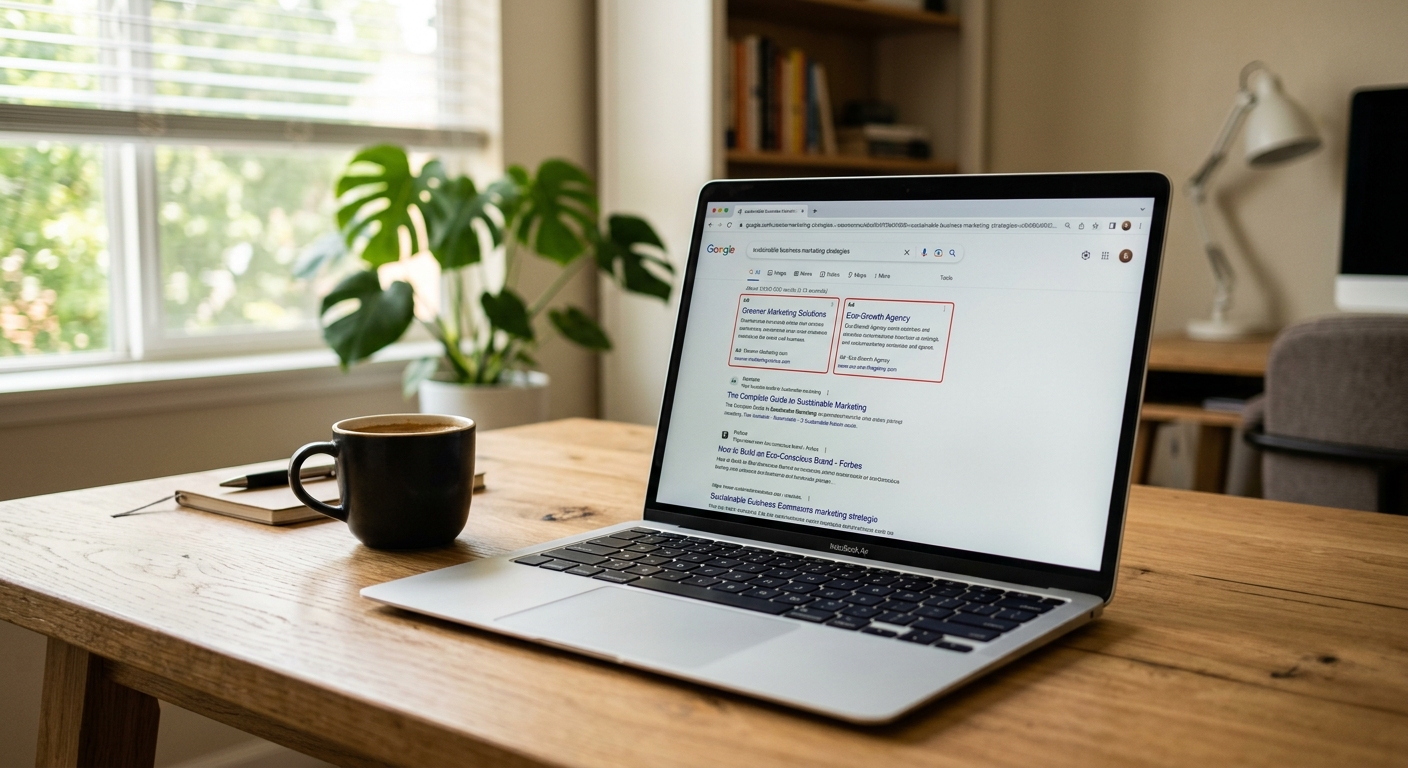
Search Engine Optimization (SEO) and Google Ads both put your business in front of people searching for what you sell. The similarity ends there. SEO builds unpaid visibility in search results over time. You pay for the work, not each visitor, and the results take months to arrive but continue without ongoing per-click cost. Google Ads places your business at the top of search results immediately. You pay every time someone clicks, and the traffic stops the moment you stop paying. For a small business with a limited budget, both channels rarely make sense at once. The right starting point depends on three things: how long your business has been operating, how soon you need leads, and how much you can spend per month. New businesses with tight timelines generally start with ads. Established businesses with six months of patience generally start with SEO. This article walks through the conditions that favor each channel and closes with concrete budget scenarios at the $500, $1,500, and $3,000 per month marks so you leave with an actual recommendation, not a hedge.
Why “Do Both” Is Not an Answer
Most articles on this topic are written by agencies that sell both services. That creates a predictable outcome: both channels get recommended, the piece is framed as complementary, and you close the tab with no clearer answer than when you opened it.
Agencies that sell SEO and Google Ads together have a financial reason to recommend both. That is not a knock on them. It is just the incentive structure. This site doesn’t sell either service, which means it can give a different answer.
The honest framing of the question is not “which is better?” It is “given my budget and timeline, which should I start with?” Those are different questions. The second one has a real answer.
What SEO Actually Does (and How Long It Takes)
SEO is the work of improving where your business appears in organic search results. “Organic” means the unpaid listings below the ads at the top of a search results page. A click from an organic listing costs nothing. The investment goes into the work itself: writing content, fixing technical issues on the site, earning links from other websites, and optimizing your Google Business Profile if you’re a local business.

Results take time. For a newer website or one with limited existing authority, expect 3 to 6 months before rankings start moving in a meaningful direction, and 6 to 12 months before organic traffic becomes a consistent source of leads. “Domain authority” is the shorthand for how much credibility Google has assigned to your site based on its age, content, and the quality of sites that link to it. A new site has little of it. That is why new sites take longer to rank. The domain has not yet earned the signals Google uses to trust it. For a deeper breakdown of what affects the timeline, how long SEO actually takes depends on your site’s history, the competition, and the specific keywords you are targeting.
The upside: once SEO works, it keeps working. A page that ranks on page one today can still drive traffic two years from now without you paying for each visit. The risk is upfront: you invest in work that takes months to produce returns, and there is no guarantee of a specific return date.
What Google Ads Actually Does (and What It Costs to Run)
Google Ads is a pay-per-click (PPC) system. You bid on keywords, your ad appears at the top of the results page when someone searches for those terms, and you pay each time someone clicks. “Pay-per-click” and “cost-per-click” (CPC) describe the same cost model from different angles: one is the mechanism, one is the metric.
The immediate benefit is real. A new campaign can be live within a day. You do not wait months. The cost is also real. In most local service categories, cost-per-click runs $10 to $30. Competitive niches like legal, financial services, and HVAC run higher. At a 5% conversion rate and a $20 CPC, acquiring one customer costs roughly $400 in ad spend. Whether that works depends entirely on what that customer is worth to your business.
The critical risk: traffic stops the moment the budget does. There is no residual benefit from past spend. If you pause a campaign, the visibility disappears with it.
Google Ads also requires active management. Campaigns that run unmanaged tend to bleed money on irrelevant search terms and underperforming ad variations. Google’s Quality Score system rewards well-structured campaigns with lower CPCs, but getting there takes testing and ongoing attention.
When SEO Makes More Sense for Your Business
SEO is the right starting channel when several conditions line up:
- You have time. You are not in a cash-flow crisis that requires new leads in the next 60 to 90 days. The 3 to 6 month ramp is not a problem you can spend your way around.
- People search for your service regularly. If there is consistent monthly search demand for what you offer, SEO compounds over time. Seasonal businesses or one-time services are different cases.
- Your business has been operating for at least a year or two. An older site comes with accumulated signals Google uses to assess credibility. Starting from a domain with history shortens the timeline.
- Trust matters before the sale. Professional services, healthcare, home improvement, and financial services are categories where buyers read and research before contacting anyone. Organic results carry an implied credibility that paid ads do not. Showing up in unpaid results is a trust signal, even if the visitor doesn’t consciously think about it.
- You have content potential. If your business can produce useful guides, FAQs, and educational content that people search for, SEO can build traffic across many pages over time, not just one.
- Your competitors haven’t built a strong SEO presence yet. In some local niches, the competition is thin. That is a window worth taking while it’s open.
Is SEO worth it for small businesses? In the right conditions, yes. In the wrong conditions (new site, competitive terms, urgent timeline), the same money and effort will produce more in six months from a well-managed ad campaign.
When Google Ads Makes More Sense for Your Business
Google Ads is the right starting channel in a different set of conditions:
- You’re a new business. A brand-new domain has no page authority, no index history, and no backlink profile. SEO on a new site takes the longest to produce results. Ads get you visible on day one.
- You have a seasonal window. A landscaping company in February or a tax preparer in December does not have time for SEO. Ads can be turned on when the buying window opens and paused when it closes. SEO cannot be timed that way.
- Your margins support the cost-per-click. A service with a high average transaction value can absorb a $30 CPC and still profit. A low-margin business with a $50 average sale cannot.
- You’re testing a new offer or market. Before investing in a long-term SEO strategy for a new service line, ads can confirm whether there’s actual demand. Use the click data to make the SEO investment decision.
- You need revenue to keep the business running. If the business needs leads in the next 30 days to make payroll or cover overhead, SEO’s six-month ramp is not a solution. Ads are.
- You’re entering a new city or service area. Zero local presence means zero organic authority in that market. Ads let you show up immediately while you build the local SEO foundation over time.
When You Actually Need Both
Some situations genuinely call for both channels at once, but the conditions are specific:
An established business with stable revenue can fund a 6 to 12 month SEO ramp while running ads to maintain lead flow in the meantime. Ads keep the phone ringing while SEO is being built. That is a real use case, not a hedge.
High-ticket services where a single closed job can cover weeks of ad spend are another fit. The math works, so you can run ads while building the long-term channel simultaneously.
Markets where organic ranking is achievable but takes 12 or more months to get there also support a both-channels approach. Ads bridge the gap while the SEO builds. By the time organic traffic arrives, you have data from the ad campaigns to inform which pages and offers deserve the most SEO attention.
The distinction worth keeping: “both” is only the right answer when your budget genuinely supports two real investments. A $1,500 budget split into $750 ads and $750 SEO usually produces two underpowered efforts rather than one effective one.
Budget Scenarios: $500, $1,500, and $3,000 per Month
This is the section most people read twice.
| Budget | Google Ads | SEO |
|---|---|---|
| $500/mo | Not recommended in most local service markets. Most keywords run $10-$30/click. You’d exhaust the budget on 20-50 clicks, which isn’t enough data to optimize. | Better fit. This covers Google Business Profile optimization, a handful of targeted pages, and foundational citation work. Or hold the budget until you can commit to a real engagement. |
| $1,500/mo | Viable for a focused campaign in a single service area. Enough budget to run, test, and optimize over 60-90 days, but not enough margin for waste. Needs active management. | Viable for a real SEO engagement with a reputable provider. Content, technical work, and some link building. Not a premium retainer, but enough to make genuine progress. |
| $3,000/mo | Can support a well-managed campaign with multiple ad groups and room to test offers and landing pages. | Enough for a substantive engagement with content production, link building, and local SEO. |
At $500/month: Google Ads is probably not the right move. You’ll burn through the budget before you have enough click data to know if it’s working. A better use of $500 is foundational SEO: optimize your Google Business Profile (it’s free, but proper optimization takes effort), build out a few core service pages, and clean up any technical issues on the site. Or save the $500 and build toward a real budget. Local SEO for small businesses like Google Business Profile work can start generating visibility at low cost and is worth doing regardless of which primary channel you choose.
At $1,500/month: This is the decision point. Enough for a modest Google Ads campaign or a real SEO engagement, but rarely both at once. For a new business: put it in ads. For an established business that can wait six months: put it in SEO. Pricing varies widely depending on scope and provider quality. If you’re evaluating what $1,500/month actually buys from an SEO provider, what SEO services cost breaks down what different budget levels typically include.
At $3,000/month: This is where running both becomes feasible if you split thoughtfully. A reasonable starting point: $1,500 in ads to maintain lead flow immediately, $1,500 in SEO to build the long-term channel. If you’re a newer business that needs leads fast, you could weight it $2,000 ads / $1,000 SEO. If you’re established and patient, flip it. Agency retainer quality at this level varies considerably. Know what you’re getting before you sign.
Frequently Asked Questions
What’s the main difference between SEO and Google Ads?
SEO builds unpaid search visibility over time. You pay for the work, not each click, and results build gradually over months. Google Ads places you at the top of search results immediately, but you pay every time someone clicks, and the traffic stops when you stop paying. One is a long-term investment. The other is a tap you turn on and off.
How long does SEO take to show results?
For a newer website or one with little existing authority, expect 3 to 6 months before you see meaningful movement in rankings and 6 to 12 months before traffic becomes a consistent business driver. Established sites in low-competition niches can see results faster. There is no honest answer shorter than that.
Is $500/month enough for Google Ads?
In most local service markets, no. Cost-per-click in competitive categories runs $10 to $30 or more. At $500/month, you might get 20 to 50 clicks before the budget runs out, which isn’t enough data to optimize the campaign. Either increase the budget or redirect that $500 to foundational SEO work like Google Business Profile optimization.
What should a brand-new business do first?
Google Ads. A new business has no domain history, no page authority, and no organic rankings. SEO on a brand-new site takes the longest to produce results. Ads get you visible immediately, which is what a new business needs while it builds the long-term organic foundation in parallel (if budget allows) or as the primary driver until revenue supports an SEO investment.
Do I need to hire an agency to run Google Ads?
Not necessarily, but poorly managed campaigns waste money quickly. If you have time to learn the basics and a modest budget, self-managing is possible. For budgets over $1,000/month, a managed campaign typically produces better returns than a self-run one, but you should understand enough to evaluate whether your agency is actually optimizing.
Can SEO traffic replace paid ads eventually?
For some businesses, yes. If you operate in a niche with consistent search demand and you build strong organic rankings, SEO traffic can reduce or eliminate dependence on paid search. This typically takes 12 to 24 months and requires ongoing content and link-building work. It is not a guaranteed outcome, but it is a realistic one for businesses with patience and a long-term content strategy.
What happens to my Google Ads traffic if I stop paying?
It stops immediately. There is no residual benefit from past spend. The moment a campaign is paused or the budget runs out, your ads stop appearing. This is the core tradeoff: ads provide instant visibility that is entirely dependent on continued spend. SEO traffic, once earned, continues without ongoing per-click cost.
What to Do With This Information
The decision framework is straightforward. New business or urgent timeline: start with Google Ads and build your organic presence on the side if budget allows. Established business with six months of patience: SEO is likely the better investment. Both channels at once: only if your budget genuinely supports two real efforts, not two underpowered ones.
If you’ve decided SEO is the right move, how to choose an SEO company is the next useful read. If you’re still figuring out the timeline side of the equation, the SEO timeline guide covers what to expect month by month based on your starting point. Either way, you now have a clearer frame for the decision than “do both.”